Futures Trading Strategies for Beginners: How to Start Without Blowing your Account (2026)

Futures trading has become one of the most talked-about ways to trade the markets — especially with the rise of micro contracts and proprietary trading firms (prop firms). What used to be a game reserved for institutions is now accessible to everyday people looking to build an additional income stream.
That said, let’s be clear: futures trading is not easy money. Most beginners don’t fail because futures don’t work — they fail because they start with the wrong expectations, too much risk, and no real strategy.
This article breaks down beginner-friendly futures trading strategies, explains which markets are best for small accounts, and shows why prop firms are often a less risky way to learn futures trading before putting your own cash on the line.
What Is Futures Trading (Plain English for Beginner Traders)
Futures trading allows you to speculate on the price movement of assets like the S&P 500, Nasdaq, gold, oil, and more — without owning the asset itself. You’re trading contracts that move with price. 
Why people like futures:
-
You can trade up or down
-
High liquidity
-
Clear rules and centralized exchanges
-
Ability to start with micro contracts instead of full-size contracts
Why beginners struggle:
-
Leverage magnifies losses
-
Emotional trading
-
Overtrading small accounts
This is why strategy and risk management matter more than indicators.
Beginner Futures Trading Strategies That Actually Make Sense
1. Trend-Following Strategy (Best for New Traders)
Trend trading is one of the simplest and most effective strategies for beginners.
The idea is simple: trade in the direction the market is already moving instead of trying to predict reversals.
How it works:
-
Identify an uptrend or downtrend
-
Enter on pullbacks
-
Exit at logical targets, not greed
Common tools:
-
20 EMA and 50 EMA
-
VWAP
-
Market structure (higher highs / lower lows)
This strategy works very well on Micro Nasdaq (MNQ) and Micro S&P 500 (MES).
2. Support and Resistance Trading
Support and resistance teaches beginners how price actually behaves.
Key levels include:
-
Previous day high and low
-
Premarket high and low
-
Big round numbers (psychological levels)
Beginner approach:
-
Buy near support
-
Sell near resistance
-
Use tight stop losses
This strategy helps new traders stop chasing price and start thinking like professionals.
3. Break and Retest Strategy 
One of the most beginner-friendly continuation strategies.
Steps:
-
Price breaks a key level
-
Pulls back to that level
-
Holds and confirms
-
Trade in the direction of the break
Why beginners love this:
-
Cleaner entries
-
Smaller risk
-
Fewer fakeouts
4. My Favorite Futures Trading Strategy: Opening Range Breakout (ORB)
The ORB strategy focuses on the first real move of the trading session.
How it works:
-
Mark the high and low of the first 5–15 minutes
-
Trade the break
This strategy works, but it’s fast. If you’re easily emotional or hesitant, it may not be the best place to start.
Best Futures Markets for Small Accounts
Not all futures contracts move the same.
Best for beginners:
-
MES – Micro S&P 500
-
MNQ – Micro Nasdaq
-
MGC – Micro Gold
Avoid early on:
-
Crude oil
-
Natural gas
-
Anything with wild, unpredictable volatility
Risk Management Is the Real Strategy for Futures Trading
No strategy works if risk isn’t controlled.
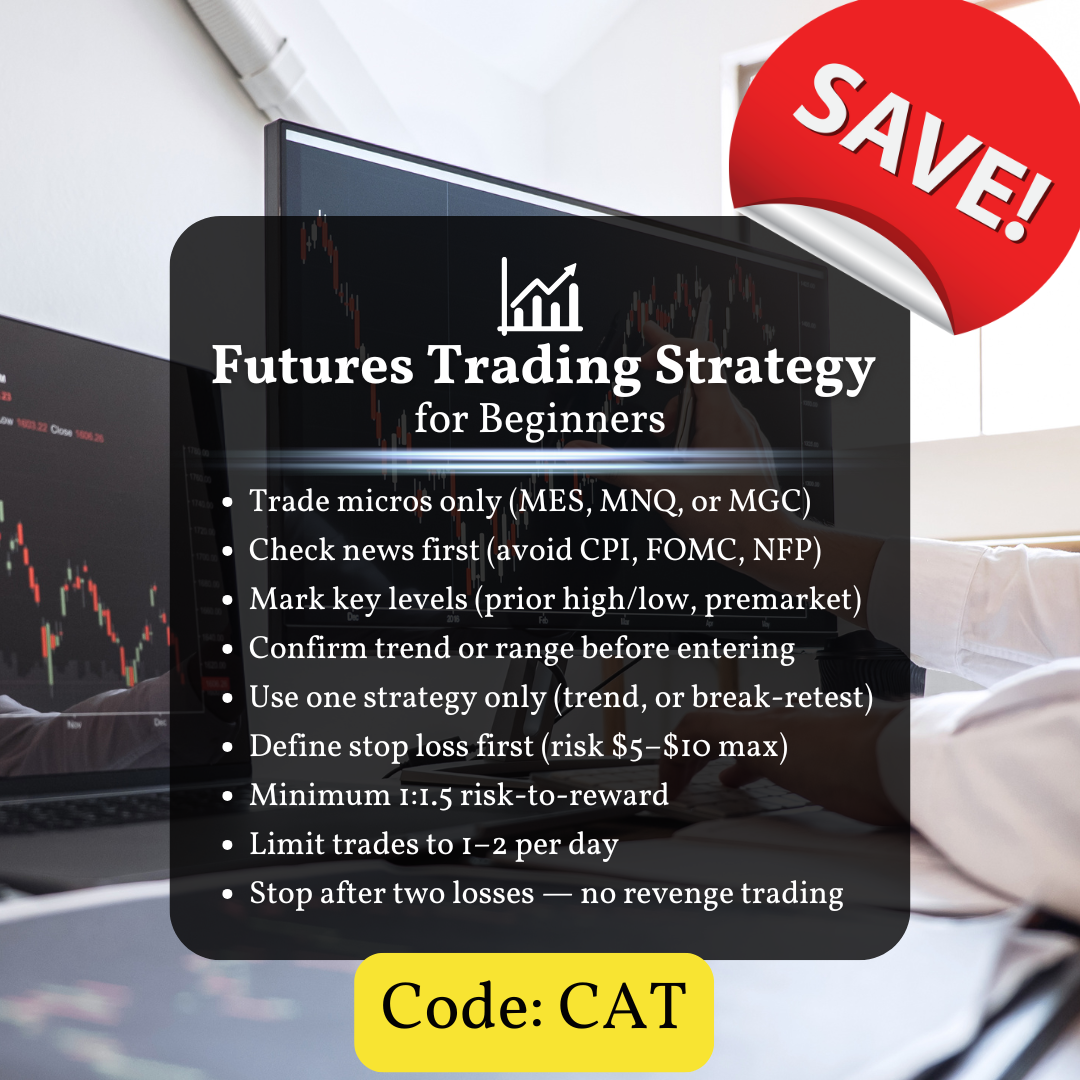
Beginner rules I stand by:
-
Risk $5–$10 per trade
-
Trade 1–2 times per day
-
Stop trading after two losses
-
Always use a hard stop loss
Most blown accounts aren’t caused by bad setups — they’re caused by too much size and too many trades.
Cash Accounts vs Prop Firm Accounts (What Beginners Need to Know in 2026)
One of the biggest decisions new futures traders face is whether to trade a cash account or start with a prop firm.
Cash Accounts for Futures Trading Strategies 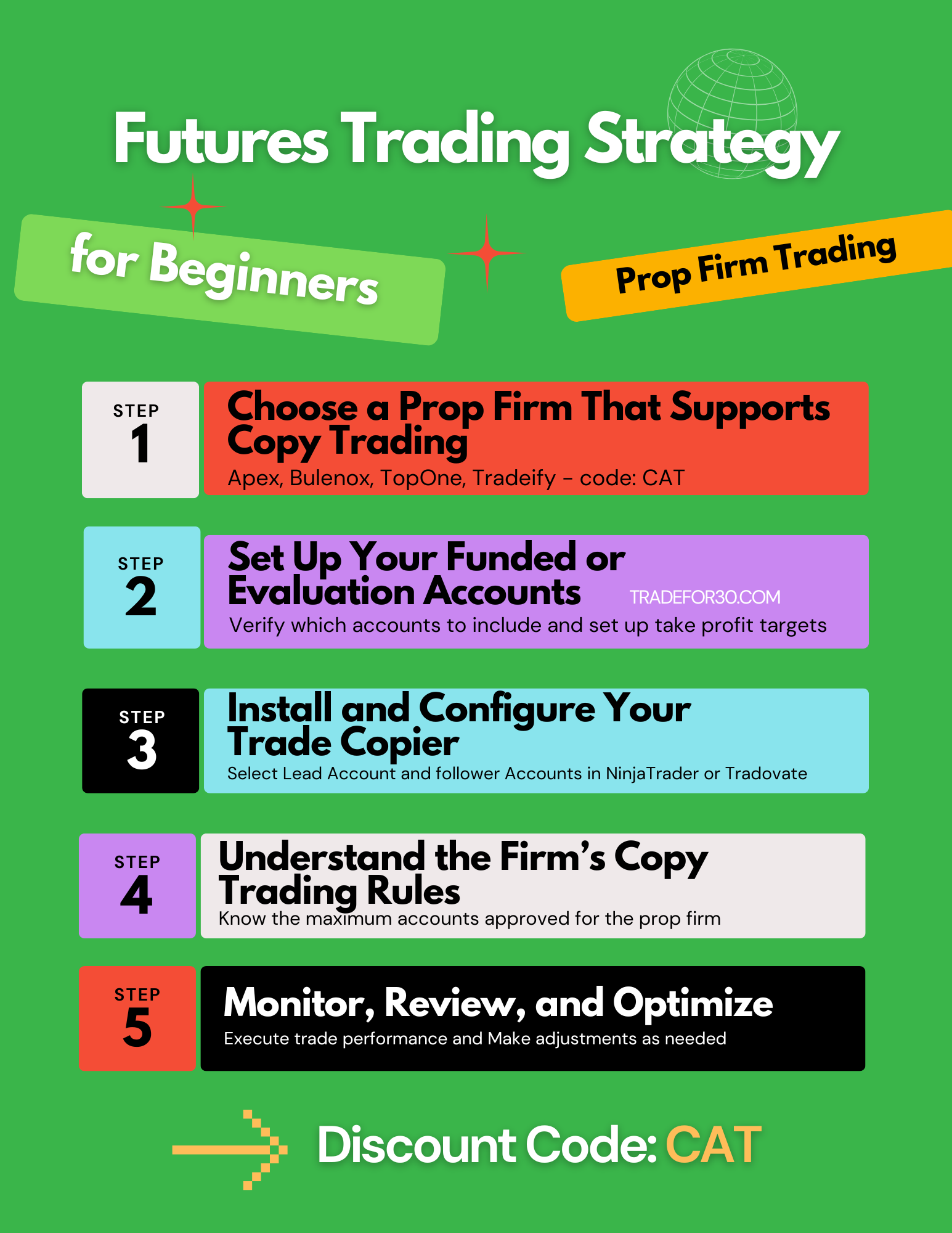
With a cash account, you’re trading your own money.
Pros:
-
Full control
-
No evaluation rules
Cons:
-
Your capital is fully at risk
-
Emotional pressure is higher
-
Small accounts get wiped out quickly
-
No guardrails to stop bad behavior
Blowing a $300 or $500 account can end a beginner’s trading journey before they even develop skill.
Prop Firm Accounts for Futures Trading Strategies
Prop Firms for Futures Trading allow you to trade their capital after passing an evaluation.
Why prop firms are less risky for beginners:
-
You risk a small evaluation fee, not thousands of dollars
-
Built-in daily loss limits force discipline
-
Most firms encourage trading micro contracts
-
You learn risk management before scaling
-
You gain experience without blowing personal savings
For many beginners, failing a prop firm evaluation is cheaper and more educational than blowing a cash account.
@catinathebroker Prop Firm for Futures Trading #propfirmtrader #propfirmsuccess #propfirms #apextraderfunding #apexcouponcode #ninjatrader8 ♬ Banana (feat. Shaggy) [DJ FLe - Minisiren Remix] - Conkarah
Using TradingView to Practice Futures Trading as a Beginner
TradingView is one tool I strongly recommend for beginners learning futures trading. TradingView is a powerful charting platform used by both retail traders and professionals to analyze markets in real time.
For beginners, TradingView is especially helpful because it allows you to practice futures trading strategies without risking real money.
Why TradingView Is Beginner-Friendly
-
Clean, easy-to-read charts
-
Access to micro futures contracts like MNQ, MES, and MGC
-
Built-in indicators such as moving averages, VWAP, and RSI
-
Paper trading mode to practice strategies risk-free
-
Works on desktop, tablet, and mobile
Many new traders make the mistake of jumping straight into live trading before they fully understand price movement. TradingView allows you to study trends, support and resistance, and break-and-retest setups in a low-pressure environment.
How Beginners Can Use TradingView Effectively
-
Practice marking support and resistance levels
-
Learn how price reacts around VWAP
-
Replay past market sessions to study setups
-
Test futures trading strategies before using real capital
-
Build confidence before trading a cash or prop firm account
TradingView pairs extremely well with prop firm trading, since many prop firms require strict risk management. Practicing on TradingView first helps traders learn patience, discipline, and execution — skills that matter far more than fancy indicators.
TradingView + Prop Firms = Smarter Learning
Instead of risking a small personal account, beginners can:
-
Learn strategies on TradingView
-
Practice execution with paper trading
-
Apply those skills inside a prop firm environment
-
Trade micro contracts with built-in risk rules
This approach significantly reduces the chances of blowing a small account and helps traders focus on consistency over quick wins.
Final Thoughts about Futures Trading Strategies for Beginners
Futures trading can be a powerful income skill — but only when approached with structure, patience, and discipline. Beginners should focus on:
-
Simple strategies
-
Micro contracts
-
Strict risk management
-
Learning before scaling
For traders with small accounts, prop firms offer a safer training ground to build consistency without unnecessary financial stress.
This is not a get-rich-quick game. Futures trading is a skill — and skills are built the right way or not at all.
Read Articles Similar to How i Passed Apex Trader Funding and Funding Ticks Prop Firm Challenges
- How I Passed my Prop Firm Challenge in 1 Day
- The Best Futures Trading Options for 2025
- How to Choose a Futures Trading Prop Firm 2025
- Instant Funding Prop Firm - Risk or Opportunity
- Trading Video using Prop Firm and NinjaTrader ATM Strategy
- Fast Payout Prop Firms
- Technical Analysis for Prop Firm Trading
- Low Cost Futures Trading Prop Firm
- How to Join Futures Trading Prop Firm with Low Fees
- The Influence of Economic Data in Futures Markets
- How Prop Firms help Manage Risk in Futures Trading
- The Compounding Effect in Day Trading Futures using Prop Firms
- Best Prop Firms List
- Prop Firms that Allow Copy Trading
- Day Trade Futures with $50
- Trading Futures with Prop Firms
- Prop Firms that Accept USA Traders
Do you have any comments about how to choose a futures trading prop firm? Please post them below.
Thanks again! Don't hesitate to share or repost this article.
AFFILIATE AND NETWORK MARKETING DISCLOSURE: This video and description may contain affiliate links, which means that if you click on one of the product links, I’ll receive a small commission. I won't put anything here that I haven't verified and/or personally used myself.
Disclaimer
This is not financial advice. Trading with prop firms involves risk, and results are never guaranteed. Only trade with money you can afford to lose, and always do your own research before making financial decisions.
Price Disclaimer: Sale prices and discounts mentioned in this article were based on the promotion when this article was published. Enter code Cat or Catina to see current promotion prices.
Stay connected with The Broker's Blueprint and Money Moves
Join our mailing list to receive The Broker's Blueprint and Money Moves.
Don't worry, your information will not be shared.
We hate SPAM. We will never sell your information, for any reason.